Play Journal #1 – Pac-Man
According to the article, “Game Analysis: Centipede”, during what people would refer to as a “Golden Age” of classic arcade games, many games lackluster in quality fell through the cracks of history while some like Pac-Man went on to become household names in the video game world. Pac-Man shares many of the characteristics that Rouse describes in his article on classic arcade games; It’s a single screen game that has no story, the player has an infinite amount of playtime so long as they do not run out of lives, and has a scoring/points system.
As far as gameplay goes, Pac-Man is easy enough for anyone to pick up. The player controls Pac-Man and moves him about in a maze picking up dots that grant him 10 points a pop. All the while, he is being chased by 4 different colored ghosts that move around him in random paths, and it’s the player’s job to avoid them or risk losing one of three lives if they touch the ghosts. If the player manages to consume a large, blinking coin then they receive a 50 point bonus and can deter the ghosts for a short period of time. If they consume the ghosts, the player receives up to 1600 points. The player receives one extra life for every 10,000 points earned.
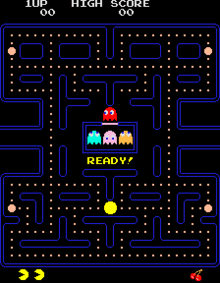
Another trait that Rouse touches on in his analysis of Centipede that he considers to be significant to that game’s success that is shared in Pac-Man is the concept of “escalating tension”. Rouse describes Centipede as having “peaks and valleys”, but I would describe Pac-Man as an infinite climb to a peak that doesn’t exist. As you progress through each level, the ghosts start to move faster and faster and begin to chase after you with predictive movements rather than randomly encountering you. The larger coins that allow players to consume the ghosts also lose their effectiveness in later levels, making the time that Pac-Man is able to consume them much shorter every time. However, to provide some sort of a cushion to the raising difficulty, there are various fruits available that grant larger point values, thus making the climb to an extra life a little more feasible.
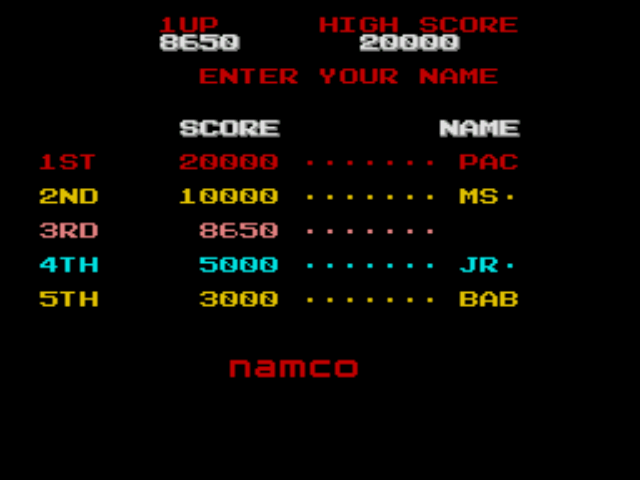
Pac-Man has all of the hallmark traits of what Rouse describes as a truly “classic arcade” game. It is a perfect blend of simplicity that draws in any and all who desire to drop in a few quarters to play, and slowly but surely cranks up the difficulty. At the end, the “bragging rights” that Rouse mentions come into play in a big way as the game can show which players have the highest scores, which results in players wanting to beat whoever is above them.
It isn’t the most technologically advanced game, but it is and will always remain a classic in the hearts of gamers all around.
 RTF 331P Play Journal (Jae Bak)